


Personal Projects
This page showcases a diverse range of work spanning data analysis, machine learning, risk evaluation, and web design. Each project reflects my passion for tackling real-world problems through collaboration, creativity, and technical skill.
01


Case Competition:
Sell-Side M&A Advisory Proposal for Etsy
As part of the Fall 2024 UCLA Case Study Competition, I acted as a financial advisor in a sell-side M&A transaction for Etsy, a global online marketplace for unique and handmade goods. Our team conducted in-depth industry analysis, evaluated Etsy’s business model and financials, identified strategic buyers, and developed a comprehensive valuation using DCF, trading comparables, and precedent transactions. The project concluded with a detailed advisory presentation that showcased Etsy’s strong growth prospects and unique strategic positioning within the dynamic e-commerce industry. I was mainly responsible for the company overview, analysis of precedent transactions, identification of potential buyers, and drafting investment highlights. This experience greatly deepened both my technical and collaborative skill sets. In particular, working on precedent transactions pushed me to refine my financial analysis abilities. I had to rigorously compare deal multiples, time periods, and strategic rationales to select truly comparable transactions. I also used R to visualize key transaction data, which enhanced our presentation's clarity and helped me grow more confident in using data visualization tools to support strategic insights. Applying my data skills in this context helped bridge the gap between technical analysis and clear, effective business communication. Additionally, collaborating with my teammates helped me improve my communication and coordination skills. We constantly had to integrate individual findings into a coherent narrative, and I also had to clearly communicate my work to my teammates, which strengthened my ability to explain complex ideas in an accessible way. Overall, this project gave me hands-on exposure to real-world M&A work and showed me the importance of balancing technical skills with storytelling in the business world.
Skills Learned:
-
Discounted Cash Flow (DCF) analysis
-
Comparable company analysis
-
Precedent transaction analysis
-
R and C++
-
Presentation design and formatting
-
Team collaboration
-
Verbal and written communication
02
Case Competition:
Risk Evaluation and Insurance Recommendation
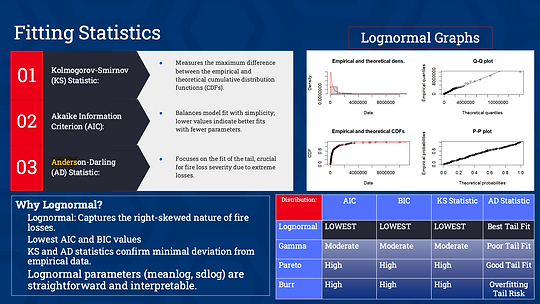
For the 2025 BAS Case Competition, our task was to evaluate and recommend an optimal insurance program for Montgomery Enterprises by analyzing simulated and historical loss data across three perils: fire, windstorm, and earthquake. We assessed multiple statistical distributions, with a focus on fire loss volatility using metrics such as the Kolmogorov-Smirnov and Anderson-Darling statistics. We conducted Monte Carlo simulations to model aggregate annual losses, compared various insurers across key financial metrics, including premium, retained loss, and Total Cost of Risk. We introduced a new metric, the Retention Efficiency Ratio, to refine our recommendations. We also emphasized professionalism and clarity in our presentation, ensuring that our findings were communicated effectively. This experience deepened my understanding of how actuarial modeling and risk analysis directly inform high-stakes business decisions. I learned not only how to apply statistical tools and simulations to quantify loss, but also how to interpret those results.
Skills Learned:
-
Statistical modeling
-
Data analysis
-
Monte Carlo simulation
-
Excel modeling and visualization
-
R
-
Presentation skills

03


Honors 50 Course Group Website:
Bruintality
This website was created as a group project for the Honors 50 course. Our goal is to showcase the diverse academic journeys of UCLA students while highlighting the shared challenges and insights that connect us all. We interviewed over 15 students from a wide range of majors, gathering their advice on academics, campus life, and navigating college. Based on the data we collected, we also developed a Study Spot Playbook—a guide to help students find the best study spaces across campus, tailored to different study needs. In addition, we produced four podcast episodes sharing our own dorm life experiences and tips for building a balanced and fulfilling college life. We hope this website is a resource that helps Bruins feel more supported and connected. Success at UCLA isn’t just about achievement—it’s also about balance, authenticity, and well-being.
Skills Learned:
-
Website design (Wix)
-
Infographic design (Canva)
-
Podcast creating
-
Team collaboration and communication
04
NSDC (National Student Data Corps) Project:
Identifying Cancer Malignancy
In this project, our team built a decision tree model to predict whether a breast tumor is malignant or benign, using visual features like radius, texture, perimeter, and concavity. The model supports clinical intuition that larger, denser tumors are more likely to be malignant. This method works well as an initial screening tool and helps confirm which features matter most before moving on to more advanced models. Future work could extend this method to other cancer types to explore broader applicability. What stood out to me wasn’t just the accuracy of the model, but how well it reflected real-world logic. It reminded me that behind every data point is a human story, and that even simple models can offer powerful insights when grounded in meaningful features.
Skills Learned:
-
Data Analysis
-
Machine Learning
-
Python


05


Data Science Project :
Penguin Species Classification
For this data-driven machine learning project, I built a clear, end-to-end workflow to predict penguin species using the Palmer Penguins dataset. I started by splitting the data into training and test sets before cleaning to avoid any leakage, then wrote reusable functions to handle missing values and formatting. I explored the data with tables and plots to see which measurements actually separate species in practice, and I narrowed the inputs to a small, sensible set that mixes one category, like island or sex, with two measurements, such as culmen length or depth, flipper length, or body mass. I trained and tuned multiple models, including support vector machines and random forests, used cross-validation to select settings, and checked performance with confusion matrices on unseen data. The best model reached over 97 percent accuracy on the test set.
Skills Learned:
-
Python
-
Matplotlib and Seaborn Visualization
-
Categorical Encoding
-
Training and Tuning
-
Jupiter Notebook Organization